
Industry context
Why surface treatment is difficult to automate
Surface treatment has traditionally been difficult to automate. Industrial components, from aircraft structures to automotive parts, vary widely in shape and condition. Sanding, polishing, grinding and deburring require precise pressure control that adapts as the tool moves across the surface.
Conventional robots excel at repeatable tasks on identical parts. When geometry or surface conditions vary, programming and setup become more demanding. Many manufacturers therefore continue to depend on skilled operators to manage tool contact, pressure and coverage.
Manual preparation across aircraft surfaces
Industry footage from the Tech Paradox presentation shows operators working across large aircraft surfaces, including areas reached from elevated platforms.
The operator’s role in tool contact
A close up of manual sanding shows the operator guiding the tool across the surface. It illustrates the continuous attention to tool position and contact that automation must address.
How the Robita platform changes the process
Robita brings an innovative approach and proven results across aerospace and automotive manufacturing, making robotic surface finishing intuitive to plan, execute and adapt.
Our proprietary platform bridges the gap between manual expertise and automation. Guided setups and reusable workflows simplify standard applications and eliminate complex programming.
Objective
Application focus
Finishing the curved lip of a jet engine fan inlet requires the tool to follow both the surface position and its changing angle. At Hive Aerospace, the demonstration focused on this contact task, followed by a hands on session showing the robot’s response to a repositioned sample. Together, the recordings connect robotic motion with the practical decisions operators make at the workstation.
Outcomes
Capabilities demonstrated
-
Following complex geometry
The sanding head tracks the fan inlet’s curved lip as the robot changes its arm configuration.
-
Adapting tool orientation
The tool angle changes along the contour to maintain alignment with the local surface.
-
Responding to part movement
A participant repositions a sample beneath the tool during the hands on demonstration.
-
Operator involvement
The team observes contact behaviour directly and discusses the process at the workstation.
Surface contact along the inlet lip
A second view shows the sanding head moving across the jet engine fan inlet’s curved lip. The changing arm posture makes the relationship between reach, tool angle and surface contact visible.
Hands on adaptation at the workstation
A participant holds and tilts a sample beneath the sanding head while the team observes the robot’s response. This sequence illustrates how workpiece movement changes the contact task.
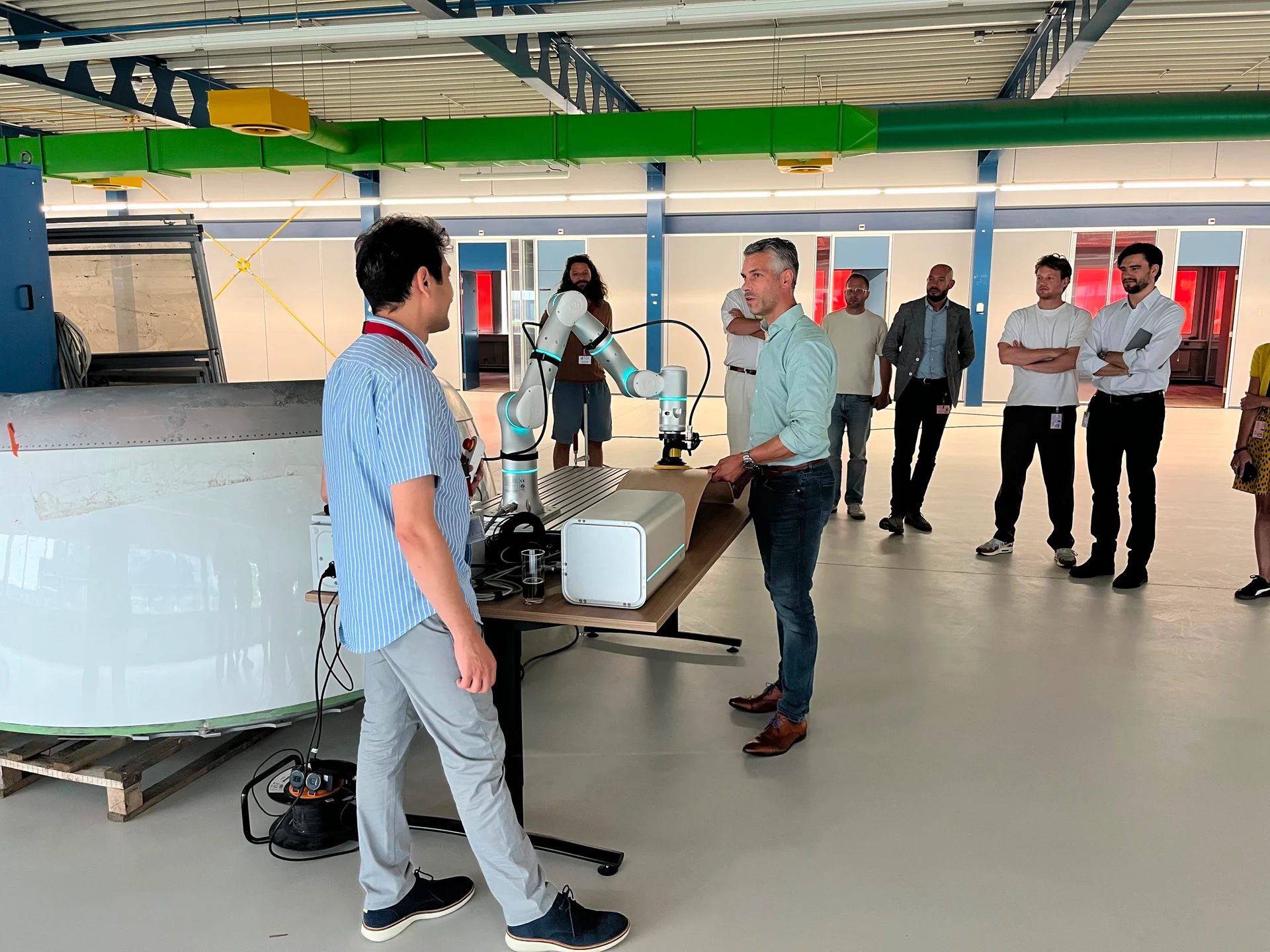
The Hive Aerospace session demonstrated contour following on a jet engine fan inlet, alongside hands on adaptation with a separate sample, providing a concrete basis for discussing aerospace finishing workflows.